Visible logistics
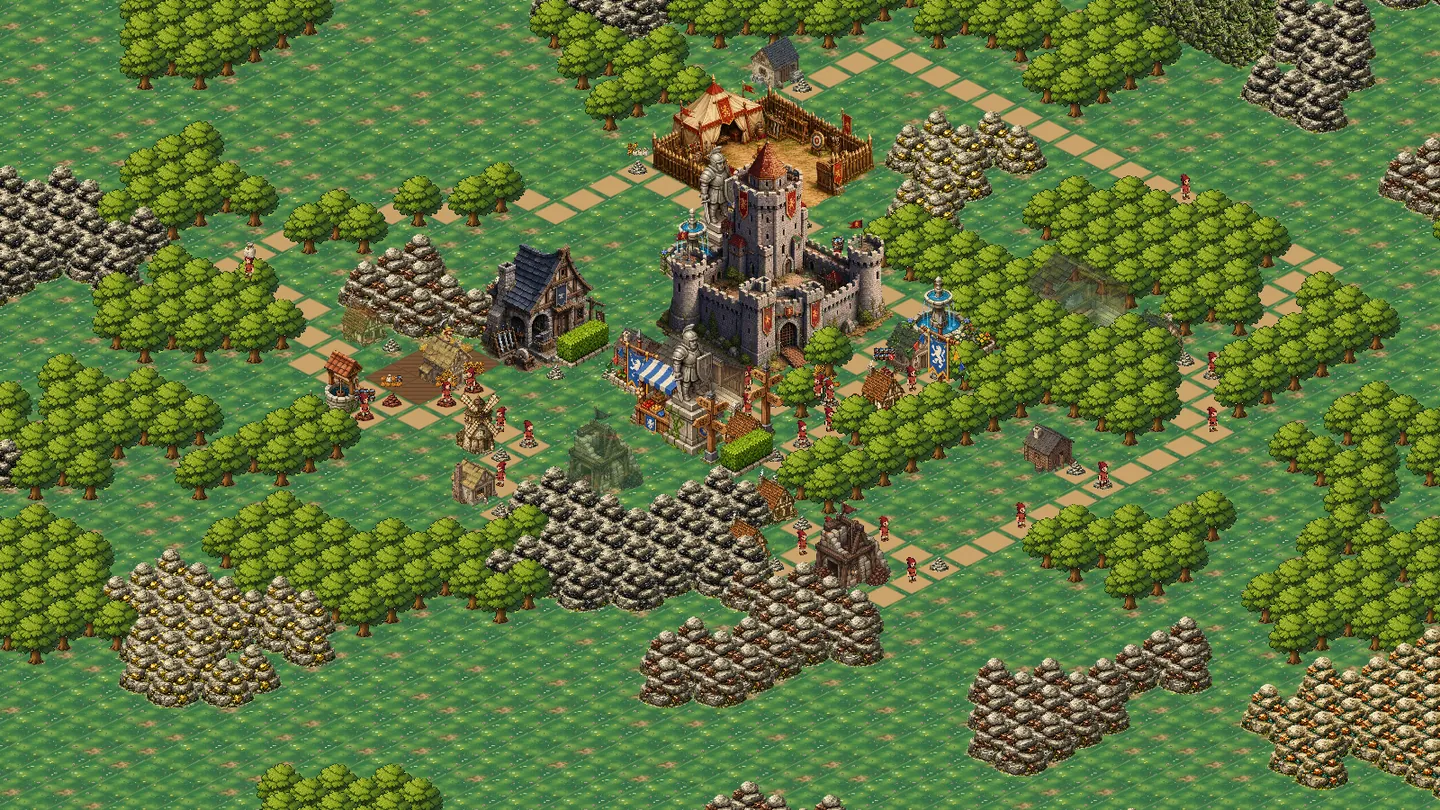
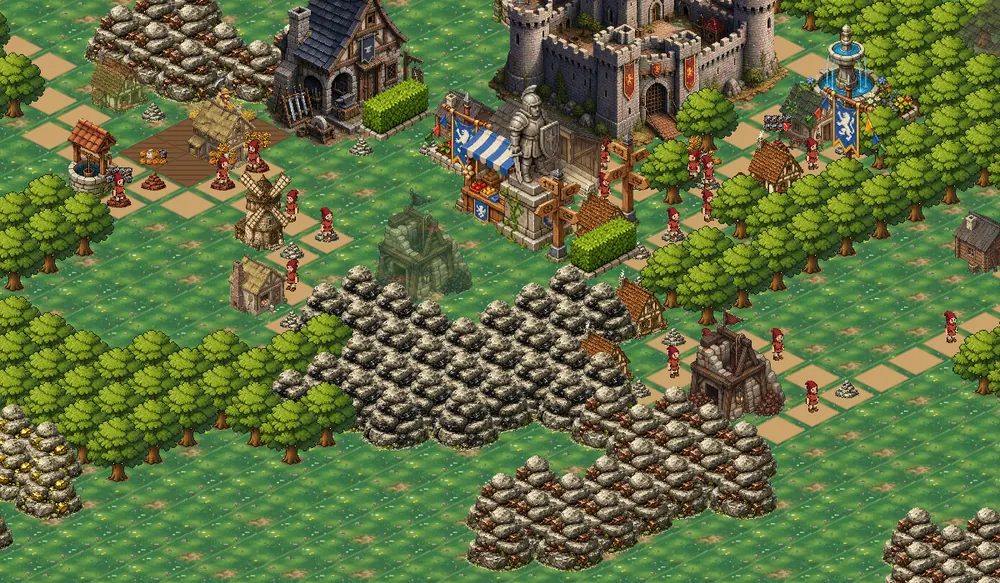
Goods travel hop by hop between cairns, each leg walked by its own carrier. A saturated cairn queues up in front of you — congestion you can see, not a hidden modifier.
Isometric colony builder · early access on itch.io
Cairnheim is a colony builder in the lineage of The Settlers. There is no abstract inventory: every plank, every loaf, every iron ingot is a physical object that a settler picks up and walks to its destination, cairn by cairn, along roads you drew yourself.
Windows desktop game, $12.99, sold in waves of fifty seats — the first wave is open. Steam comes later.
Three pillars
Most builders hide logistics behind a number that goes up. Cairnheim puts it on screen: you watch the bottleneck happen, and you fix it with a road.
Goods travel hop by hop between cairns, each leg walked by its own carrier. A saturated cairn queues up in front of you — congestion you can see, not a hidden modifier.
Workers, tools, food and road capacity pull against each other constantly. There is always an interesting bottleneck — split a route, add a cairn, or reroute the whole district.
Your colony is persistent, and it keeps working while you are away. Other players can walk through it; nobody but you can change a thing. What it becomes is the product of the hours and the planning you put into it — a colony you build the hard way, and keep.
The core loop
A road links two cairns — the stone markers that play the role of flags in The Settlers. One carrier serves one leg, and only that leg: goods are handed over from cairn to cairn like a bucket chain.
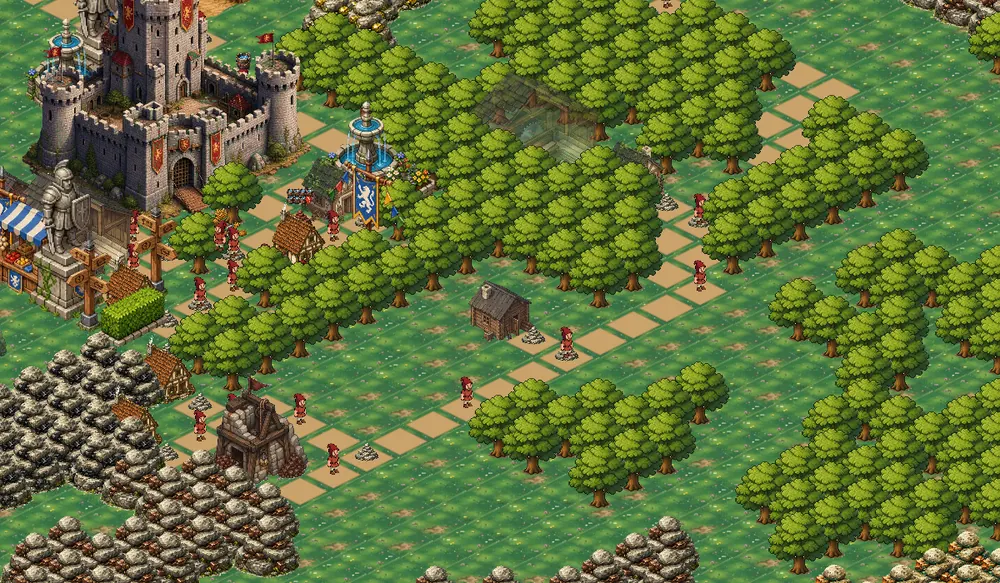
That single rule produces everything else. A long route is slow because it has few carriers. A busy cairn backs up because it holds eight goods at most. Adding a cairn in the middle of a road doesn't just shorten it — it puts another pair of legs on the network.
When several workshops want the same good, the game uses the original Settlers arbitration: the highest-priority claimant is served first, and its priority halves with every unit it already holds. A favoured workshop can't starve its neighbours forever.
Production
Twenty-nine workshops turn one good into another; eight more sit on a deposit and pull raw material out of the ground. Every chain is short enough to read at a glance and long enough to fight over transport — and they all draw on the same carriers, which is where the game actually happens.
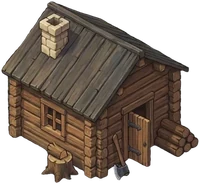 Woodcutter
→
Woodcutter
→
 Log
→
Log
→
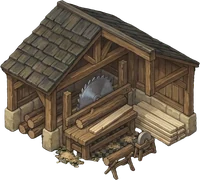 Sawmill
→
Sawmill
→
 Plank
→
Plank
→
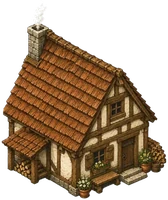 Every building
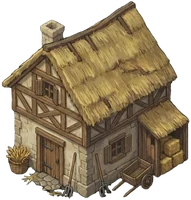 Farm
→
Farm
→
 Wheat
→
Wheat
→
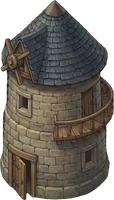 Mill
→
Mill
→
 Flour
+
Flour
+
 Water
→
Water
→
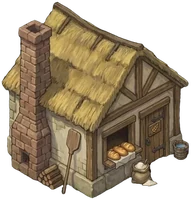 Bakery
→
Bakery
→
 Bread
Bread
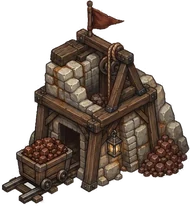 Iron mine
→
Iron mine
→
 Ore
+
Ore
+
 Coal
→
Coal
→
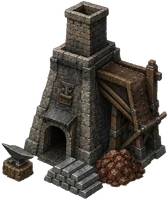 Smelter
→
Smelter
→
 Ingot
→
Ingot
→
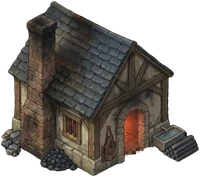 Toolmaker
→
Toolmaker
→
 Tools
Tools
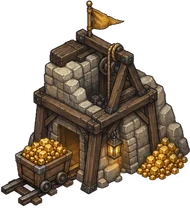 Gold mine
→
Gold mine
→
 Ore
→
Ore
→
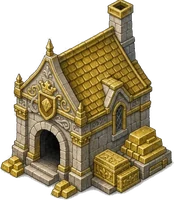 Smelter
→
Smelter
→
 Ingot
→
Ingot
→
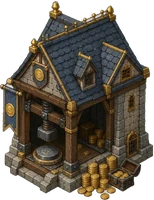 Mint
→
Mint
→
 Coins
Coins
Plus stone, fish, meat, copper, platinum, charcoal, bows, swords and the rare expedition gems — the full table is in the docs.
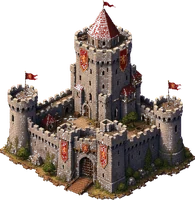 CastleHouse
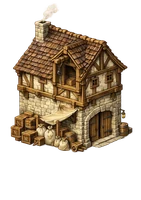 WarehouseWoodcutter
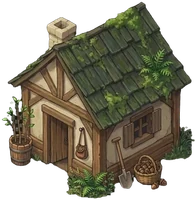 ForesterSawmill
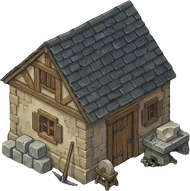 Quarry
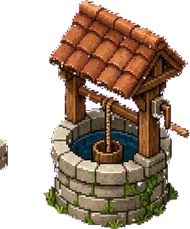 WellFarm
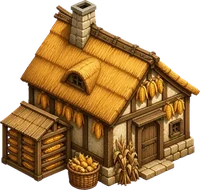 Corn farmMillBakery
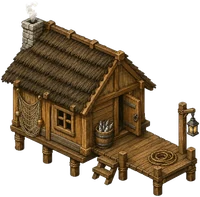 Fisher
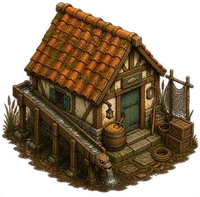 Fish farm
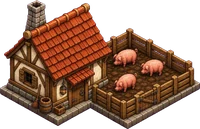 Pig farm
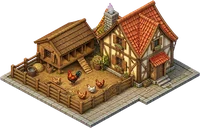 Chicken coop
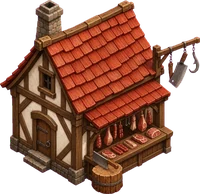 Butcher
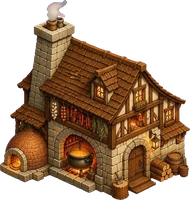 Kitchen
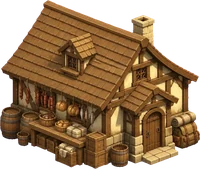 Provisioner
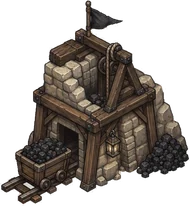 Coal mine
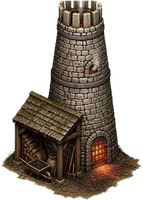 Charcoal burnerIron mineIron smelter
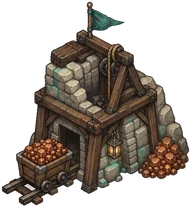 Copper mine
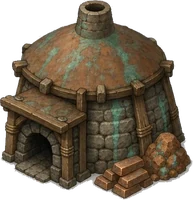 Copper smelterGold mineGold smelter
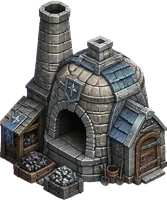 Platinum smelterToolmakerMint
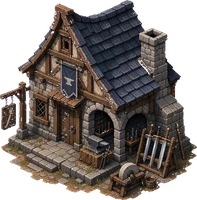 Weaponsmith
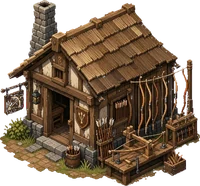 Fletcher
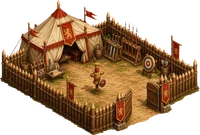 Training camp
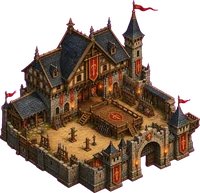 Military school
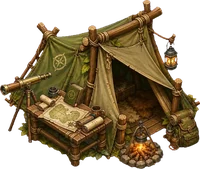 Explorer hut
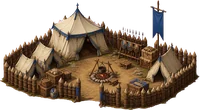 Expedition camp
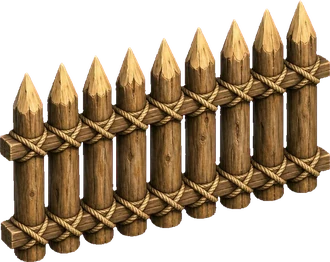 Palisade
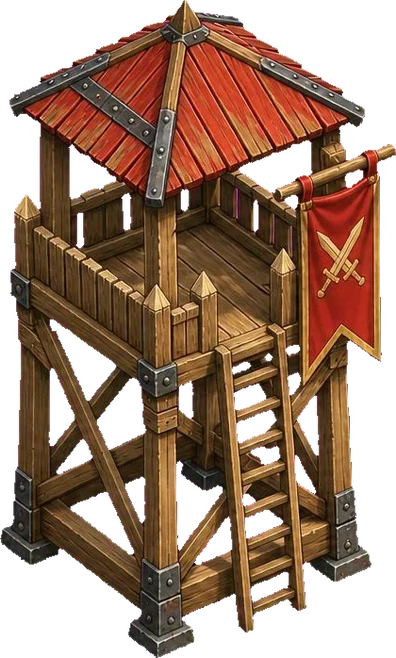 Watchtower
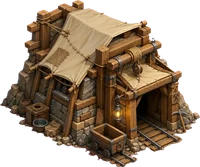 Expedition mine
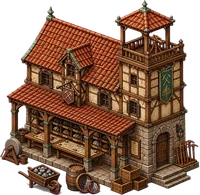 Geologists' guild
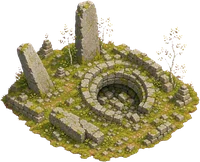 Rune Shaft
 Chapel
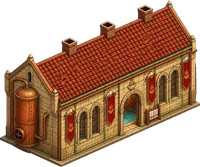 Bathhouse
 Temple
The monument
Every colony starts with a collapsed shaft it did not build. Restoring it is the long project the rest of the economy exists to serve — the clearest measure of how far a colony has come.
Ruin → Shored (30 stone, 30 planks) → Awakened (200 marble, 200 platinum). Each stage raises the shaft's Strike. That is all it does, and it is enough.
Strike is the shaft's output, and the plainest badge of a mature colony. A deeper working is a bigger achievement — built the hard way, one pick and one supply line at a time. It is the endgame the whole map works toward.
The base shaft burns nothing and never stops. Every pick you set beyond it eats emberwood — charcoal from the burners, never the mountain coal your smelters need: 40 per hundred strikes at first, down to a hard floor of 12. You buy that efficiency with diamonds — and with comfort. Push the shaft further and the bill widens: stone and planks past 150 added Strike, iron and copper past 400, wages past 800. A deep shaft is an industrial estate, not a purchase.
A crew that lives well works cleaner. Three buildings, one of each per colony, close a share of the gap between your current Thrift and its floor:
They are the reason the copper and gold chains exist past the toolmaker. All three unlock only once the shaft is Awakened.

The world
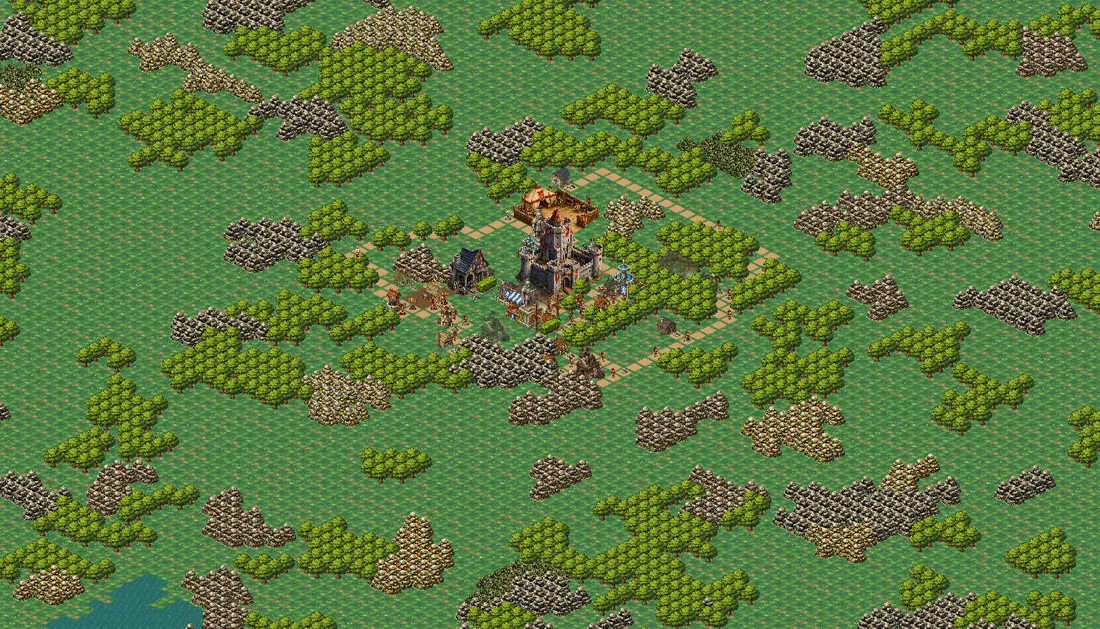
Every resource on your map runs out — and every one of them can be brought back, by somebody whose whole job that is. A forester replants what the woodcutter fells. A fish farmer restocks the lake the fisher empties. And an exhausted rock, coal or ore deposit is reopened on the spot by a geologist: 25 coins a mission, five minutes of digging, and the seam comes back full — not patched, full, so you decide when to send one instead of being nagged.
Nothing on your own ground is therefore lost for good, and nothing is free either: every renewal costs a worker, a walk and a wage. The exception is platinum — it exists only on the expedition isles, and no geologist sails. What you bring back from out there, you will not be making at home.
You start with ten colonists. More are recruited with coins — 8 apiece. Coins are also what a large rune shaft pays its crew in wages, so a working mint stops being optional the moment it gets serious.
Hunger never kills anyone. Running out of food slows production down to half speed and no further: the game punishes you with a bad hour, never with a death spiral you can't escape.
Beyond your own map there are expedition islands — instanced, hostile, and the only place some materials come from. You send a general, you land, you take camps off bandits, and you mine what you came for.
Roadmap
Built in the open, in order, with no step skipped.
Pillars, loops, the economy and the guardrails that come with them.
Cairn-and-road transport, 44 buildings, 41 goods, workers who walk out to the resource, population and morale, tools, an army, cloud saves. Everything on this page is running today.
Instanced expedition islands with bandit camps to take, explorers and geologists with their own skill tree, and the rune shaft with its three stages and its emberwood sink. The two isles are hand-authored maps, not generated ones — Marble at 96 × 96 tiles and Platinum at 48 × 48, each with its own veins and camps placed by hand.
Cairnheim is on sale as a desktop game: a one-time purchase, no subscription and no crypto. It is sold in waves of fifty seats at $12.99 — the server has never held more than eight colonies at once, and each wave opens only after the last one has held. Steam comes next; the store page is not up yet, so there is nothing to wishlist today.
The same engine you play runs on our server and carries your colony on while you are away: carriers keep hauling, workshops keep producing, builders keep raising what you laid out. It decides nothing in your place. A world the server cannot read is set aside instead of stalling everyone else's, and every colony keeps a history of earlier versions to come back to.
Two more expedition tiers beyond the marble and platinum isles: heavier garrisons that a single kind of soldier cannot answer, two new troop types to answer them, and diamonds as the prize — the one thing that takes a shaft's fuel bill all the way down to its floor.
FAQ
Cairnheim is coming to Steam as a desktop game — download it, launch it, build. The store page and wishlisting open soon; there is nothing to install yet.
A one-time purchase on Steam — buy it once and it is yours. No subscription, no microtransactions, nothing to grind for real money.
Not in the sense of a shared map. Each player builds on their own map, the way The Settlers Online did it. What connects players today is a directory of every colony that has been played, the ability to visit any of them — look around, change nothing — and one global text channel. There is no trading and no co-op.
The output of your rune shaft — how much the restored pit brings up. It is the endgame measure of a colony: the deeper the working, the more it took to build. Nothing here scales for free; every point of Strike is paid for in construction and upkeep.
Less than you might think, and it matters less than you might think. The server checks that every colony it receives is well-formed and safe to open — not that every plank in it was earned. But nothing is traded between players, so invented resources cheat nobody but the colony's owner. Checking the economy itself becomes necessary the day goods change hands between players, and that day has not come.
The transport model is ported deliberately: cairns stand in for flags, one carrier per road leg, distribution priorities that decay by half per unit in stock. Several timings come straight from the original — a farmer's harvest, for instance, takes 7.8 seconds because that is what it took in Settlers 1.
No. Starvation slows production to a floor of 50% and never removes colonists — there is no state you can reach that you cannot climb back out of.
A small independent project. The game, the art direction and the economy are being built and balanced in public, one system at a time.
Devlog
The decisions that were hard, the bugs that were embarrassing, and the numbers behind both.
11 September 2026
The sprites are generated. Here is everything that happens between the model's output and something a game can actually use — said plainly, before anyone has to ask.
11 September 2026
It does not stop when you close the game — which means it cannot live on your hard drive. What that costs, said out loud before anyone buys anything.
10 September 2026
Forty planks, a five-plank woodcutter and an unlimited two-plank fence. Do the arithmetic in the wrong order and the colony never recovers.
The first ten minutes are a woodcutter, a sawmill and the road between them. It gets complicated on its own after that.